Pregnancy is an exciting time, but it can also be stressful. Knowing that you are doing all you can to stay healthy during pregnancy and give your baby a healthy start in life will help you to have peace of mind.
Pregnancy – the nine months or so for which a woman carries a developing embryo and fetus in her womb – is for most women a time of great happiness and fulfilment. However, during pregnancy, both the woman and her developing child face various health risks. For this reason, it is important that all pregnancies should be monitored by skilled care providers.
Pregnant women must be able to access the right care at the right time, says WHO
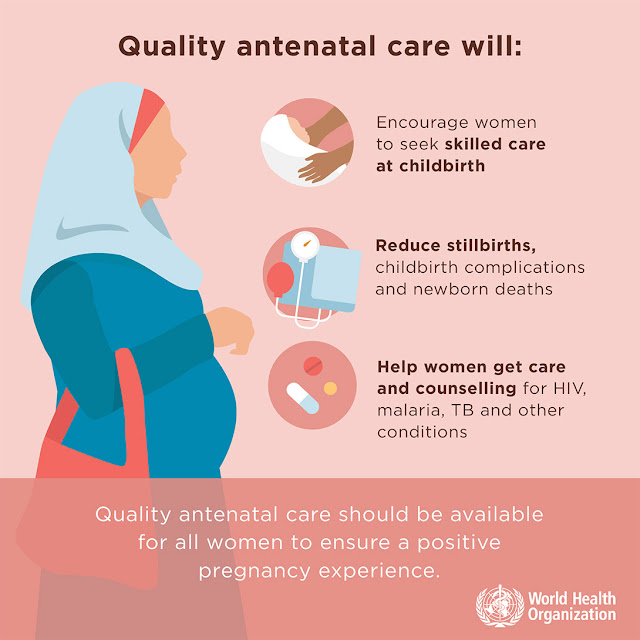
WHO has issued a new series of recommendations to improve quality of antenatal care in order to reduce the risk of stillbirths and pregnancy complications and give women a positive pregnancy experience.
Last year, 2015, an estimated 303 000 women died from pregnancy-related causes, 2.7 million babies died during the first 28 days of life and 2.6 million babies were stillborn. Quality health care during pregnancy and childbirth can prevent many of these deaths, yet globally only 64% of women receive antenatal (prenatal) care four or more times throughout their pregnancy.
Antenatal care is a critical opportunity for health providers to deliver care, support and information to pregnant women. This includes promoting a healthy lifestyle, including good nutrition; detecting and preventing diseases; providing family planning counselling and supporting women who may be experiencing intimate partner violence.
"If women are to use antenatal care services and come back when it is time to have their baby, they must receive good quality care throughout their pregnancy," says Dr Ian Askew, Director of Reproductive Health and Research, WHO. "Pregnancy should be a positive experience for all women and they should receive care that respects their dignity."
WHO recommendations on antenatal care
WHO’s new antenatal care model increases the number of contacts a pregnant woman has with health providers throughout her pregnancy from four to eight. Recent evidence indicates that a higher frequency of antenatal contacts by women and adolescent girls with the health system is associated with a reduced likelihood of stillbirths. This is because of the increased opportunities to detect and manage potential problems. A minimum of eight contacts for antenatal care can reduce perinatal deaths by up to 8 per 1000 births when compared to a minimum of four visits.
The new model increases maternal and fetal assessments to detect problems, improves communication between health providers and pregnant women, and increases the likelihood of positive pregnancy outcomes. It recommends pregnant women to have their first contact in the first 12 weeks’ gestation, with subsequent contacts taking place at 20, 26, 30, 34, 36, 38 and 40 weeks’ gestation.
"More and better quality contacts between all women and their health providers throughout pregnancy will facilitate the uptake of preventive measures, timely detection of risks, reduces complications and addresses health inequalities," says Dr Anthony Costello, Director of Maternal, Newborn, Child and Adolescent Health, WHO. "Antenatal care for first time mothers is key. This will determine how they use antenatal care in future pregnancies."
The new guidelines contain 49 recommendations that outline what care pregnant women should receive at each of the contacts with the health system, including counselling on healthy diet and optimal nutrition, physical activity, tobacco and substance use; malaria and HIV prevention; blood tests and tetanus vaccination; fetal measurements including use of ultrasound; and advice for dealing with common physiological symptoms such as nausea, back pain and constipation.
"Counselling about healthy eating, optimal nutrition and what vitamins or minerals women should take during pregnancy can go a long way in helping them and their developing babies stay healthy throughout pregnancy and beyond," says Dr Francesco Branca, Director Department on Nutrition for Health and Development, WHO.
By recommending an increase in the amount of contact a pregnant woman has with her health provider, WHO is seeking to improve the quality of antenatal care and reduce maternal and perinatal mortality among all populations, including adolescent girls and those in hard-to-reach areas or conflict settings.
WHO recommendations allow flexibility for countries to employ different options for the delivery of antenatal care based on their specific needs. This means, for example, care can be provided through midwives or other trained health personnel, delivered at health facilities or through community outreach services.
A woman’s ‘contact’ with her antenatal care provider should be more than a simple ‘visit’ but rather the provision of care and support throughout pregnancy.
Sample recommendations include:
Antenatal care model with a minimum of eight contacts recommended to reduce perinatal mortality and improve women’s experience of care.
Counselling about healthy eating and keeping physically active during pregnancy.
Daily oral iron and folic acid supplementation with 30 mg to 60 mg of elemental iron and 400 µg (0.4 mg) folic acid for pregnant women to prevent maternal anaemia, puerperal sepsis, low birth weight, and preterm birth.
Tetanus toxoid vaccination is recommended for all pregnant women, depending on previous tetanus vaccination exposure, to prevent neonatal mortality from tetanus.
One ultrasound scan before 24 weeks’ gestation (early ultrasound) is recommended for pregnant women to estimate gestational age, improve detection of fetal anomalies and multiple pregnancies, reduce induction of labour for post-term pregnancy, and improve a woman’s pregnancy experience.
Health-care providers should ask all pregnant women about their use of alcohol and other substances (past and present) as early as possible in the pregnancy and at every antenatal visit.
Antenatal care
The World Health Organization has issued a new series of recommendations to improve quality of antenatal care to reduce the risk of stillbirths and pregnancy complications and give women a positive pregnancy experience. By focusing on a positive pregnancy experience, these new guidelines seek to ensure not only a health pregnancy for mother and baby, but also an effective transition to positive labour and childbirth and ultimately to a positive experience of motherhood.
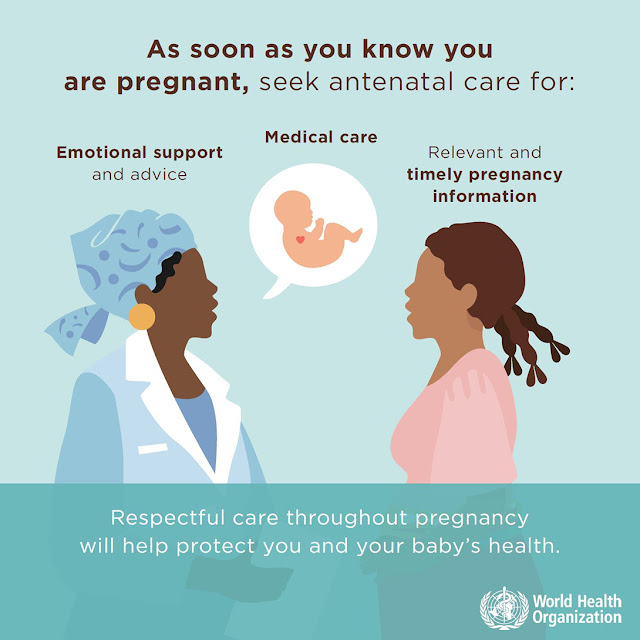
As soon as you know you are pregnant, seek antenatal care
Depression is an illness characterized by persistent sadness and a loss of interest in activities that you normally enjoy, accompanied by an inability to carry out daily activities, for at least two weeks.
In addition, people with depression normally have several of the following: a loss of energy; a change in appetite; sleeping more or less; anxiety; reduced concentration; indecisiveness; restlessness; feelings of worthlessness, guilt, or hopelessness; and thoughts of self-harm or suicide.
Something that can happen to anybody.
Not a sign or weakness.
Treatable, with talking therapies or antidepressant medication or a combination of these.
What you can do if you think you are depressed
Talk to someone you trust about your feelings. Most people feel better after talking to someone who cares about them.
Seek professional help. Your local health-care worker or doctor is a good place to start.
Remember that with the right help, you can get better.
Keep up with activities that you used to enjoy when you were well.
Stay connected. Keep in contact with family and friends.
Exercise regularly, even if it’s just a short walk.
Stick to regular eating and sleeping habits.
Accept that you might have depression and adjust your expectations. You may not be able to accomplish as much as you do usually.
Avoid or restrict alcohol intake and refrain from using illicit drugs; they can worsen depression.
If you feel suicidal, contact someone for help immediately.
Remember:
Depression can be treated. If you think you have depression, seek help.
WHO have developed a set of posters Depression: Let's talk for use in campaign activities and beyond.
Each poster depicts a conversation between two people about depression:
Hepatitis C is a virus, or infection, that causes inflammation of the liver.
Anyone can get hepatitis C, but some people are more likely to than others.
You could get hepatitis C through contact with an infected person’s blood.
Most people do not have any symptoms until the hepatitis C virus causes liver damage, which can take 10 or more years to happen.
See a doctor right away if you or a child in your care has symptoms of hepatitis C.
Acute hepatitis C is a short-term infection with the hepatitis C virus.
Chronic hepatitis C is a long-lasting infection with the hepatitis C virus. Chronic hepatitis C occurs when the body can’t get rid of the hepatitis C virus.
A blood test will show if you have hepatitis C.
If you are at higher risk of getting hepatitis C, get tested. Many people with hepatitis C do not know they are infected.
Hepatitis C usually is not treated unless it becomes chronic. Chronic hepatitis C is treated with medicines that slow or stop the virus from damaging the liver.
Tell your doctor and your dentist if you have hepatitis C.
See your doctor right away if you think you have been in contact with the hepatitis C virus. Early diagnosis and treatment of chronic hepatitis C can help prevent liver damage.
Hepatitis C does not always require treatment as the immune response in some people will clear the infection, and some people with chronic infection do not develop liver damage. When treatment is necessary, the goal of hepatitis C treatment is cure. The cure rate depends on several factors including the strain of the virus and the type of treatment given.
The standard of care for hepatitis C is changing rapidly. Until recently, hepatitis C treatment was based on therapy with interferon and ribavirin, which required weekly injections for 48 weeks, cured approximately half of treated patients, but caused frequent and sometimes life-threatening adverse reactions.
Recently, new antiviral drugs have been developed. These medicines, called direct antiviral agents (DAA) are much more effective, safer and better-tolerated than the older therapies. Therapy with DAAs can cure most persons with HCV infection and treatment is shorter (usually 12 weeks) and safer.
Although the production cost of DAAs is low, these medicines remain very expensive in many high- and middle-income countries. Prices have dropped dramatically in some countries (primarily low-income) due to the introduction of generic versions of these medicines.
Much needs to be done to ensure that these advances lead to greater access to treatment globally.
Recommendations on hepatitis C treatment
Assessing for HCV treatment
All adults and children with chronic HCV infection should be assessed for antiviral treatment.
Treatment with direct-acting antivirals (DAAs)
WHO recommends that all patients with hepatitis C be treated with DAA-based regimens, except for a few specific groups of people in whom interferon-based regimens can still be used (as an alternative regimen for patients with genotype 5 or 6 infection and those with genotype 3 HCV infection who also have cirrhosis).
Telaprevir and boceprevir should no longer be used
These 2 first-generation DAAs, which are administered with pegylated interferon and ribavirin, were recommended in the 2014 guidelines. Evidence now shows that they result in more frequent adverse effects and less frequent cures compared with newer DAA-based regimens. Thus, these 2 medicines are no longer recommended by WHO.
WHO recommends preferred and alternative DAA regimens based on genotype and cirrhosis status
The Guideline Development Group reviewed all the available data (over 200 studies) to determine which regimens were most effective and safest to treat each of the 6 different genotypes.
Hepatitis C FAQs for the Public: Treatment
Can acute Hepatitis C be treated?
Yes, acute hepatitis C can be treated. Acute infection can clear on its own without treatment in about 25% of people. If acute hepatitis C is diagnosed, treatment does reduce the risk that acute hepatitis C will become a chronic infection. Acute hepatitis C is treated with the same medications used to treat chronic Hepatitis C. However, the optimal treatment and when it should be started remains uncertain.
Can chronic Hepatitis C be treated?
Yes. There are several medications available to treat chronic Hepatitis C, including new treatments that appear to be more effective and have fewer side effects than previous options. The Food and Drug Administration (FDA) maintains a complete list of approved treatments for Hepatitis C.
Is it possible to get over Hepatitis C?
Yes, approximately 15%–25% of people who get Hepatitis C will clear the virus from their bodies without treatment and will not develop chronic infection. Experts do not fully understand why this happens for some people.
What can a person with chronic Hepatitis C do to take care of his or her liver?
People with chronic Hepatitis C should be monitored regularly by an experienced doctor. They should avoid alcohol because it can cause additional liver damage. They also should check with a health professional before taking any prescription pills, supplements, or over-the-counter medications, as these can potentially damage the liver. If liver damage is present, a person should check with his or her doctor about getting vaccinated against Hepatitis A and Hepatitis B.